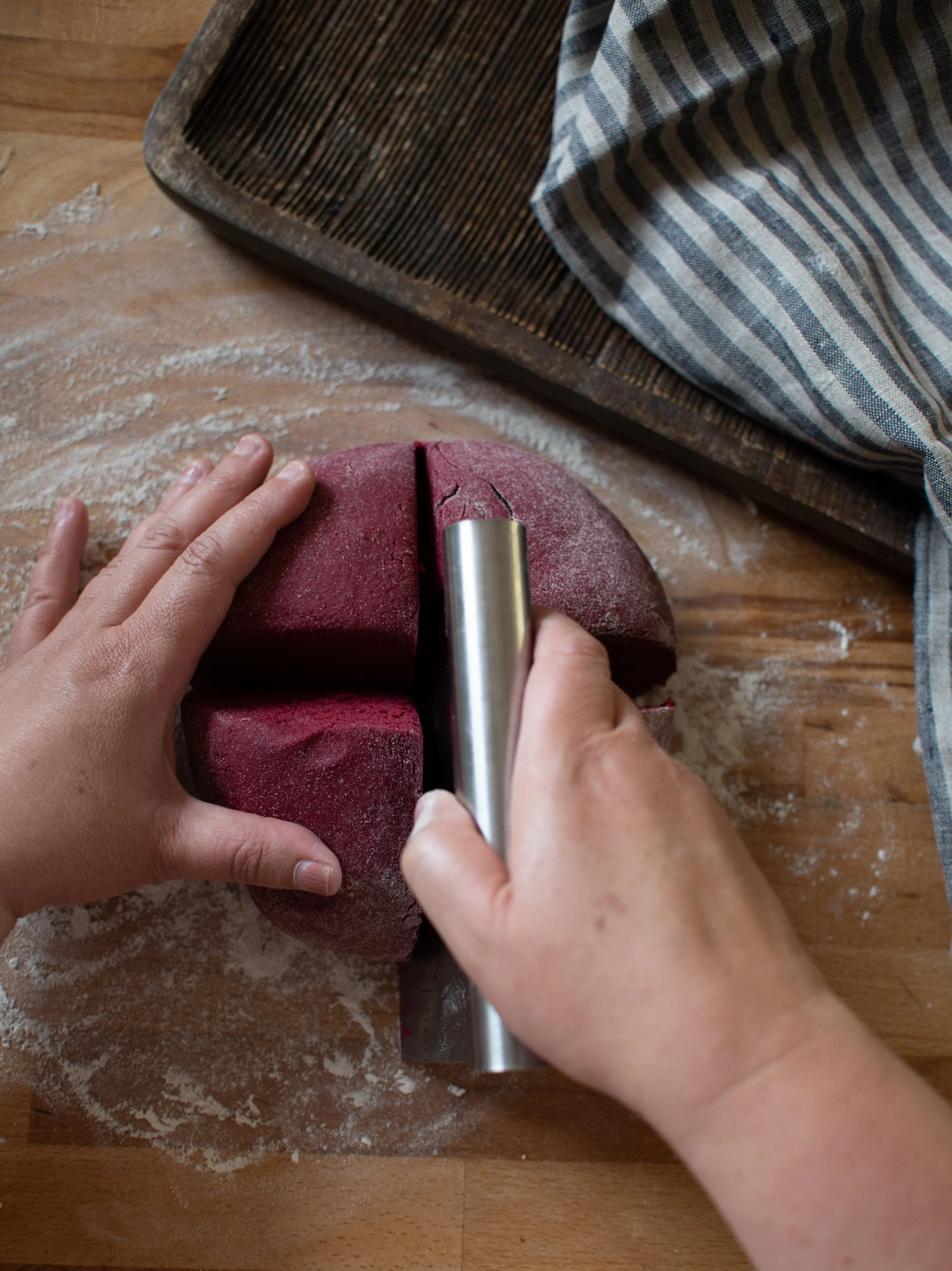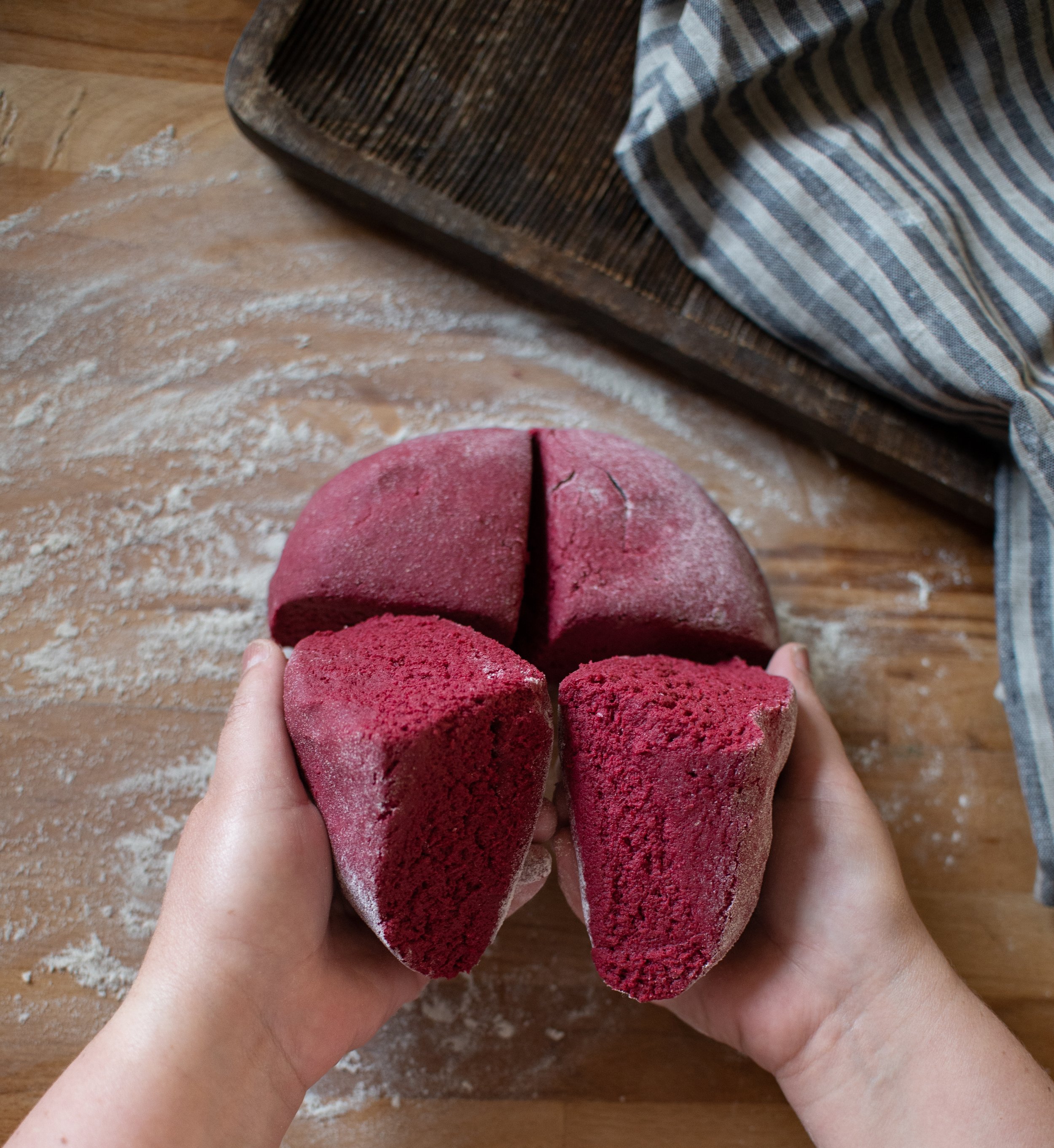

Gluten-Free Beetroot Bread
This recipe might be something you never imagined making yourself, but if you enjoy a challenge, are intrigued by the science behind it, or are simply curious about the colour and flavour of this beautiful loaf, then I dare you to try it!
I hesitated for a long time before deciding to blog about this bread. Baking gluten‑free bread is a completely different experience. There is hardly any kneading involved, and the flours, each of which must be combined in the correct ratios—are highly hydrating and sensitive. You also don’t get the usual comforting smells from the oven, and the loaf browns differently, making it difficult to judge when it’s fully baked.
I’ve perfected the timing for my own oven, but yours may run a degree or two hotter or cooler. To be safe, open the oven near the end of the baking time and tap the loaf lightly with your hand. Listen for a hollow sound; that’s your cue to remove it from the pan and let it cool. Leaving it in too long may cause it to burn.
Beetroot powder can be tricky to find. In the Netherlands, you can order it from Koro.com or Amazon.nl. When using it, you’ll need at least 50 g per 400 g of flour. After testing many beetroot bread recipes, I discovered that the pH of the dough is ultimately responsible for the colour change.
Here’s why: the pigment that gives beets their deep red colour is called betanin. It’s water‑soluble, great for natural dyeing but also sensitive to heat and pH. At the high temperatures required for baking, betanin breaks down, which is why the vibrant red often turns a dull brown.
To help preserve the colour, the pH of the dough needs to be adjusted. I use ascorbic acid (vitamin C powder), adding 2 g for every 400 g of flour. Vitamin C is a powerful antioxidant, and browning is essentially oxidation during cooking or storage.
If you’re using beetroot juice instead of powder, replace some of the water with milk. Milk has a pH of around 6.5 due to its lactic acid. Ideally, you want the dough to reach a pH of 4–5, where beet juice appears bright bluish‑red. At pH 5–7, it shifts toward blue‑violet.
Some people use crushed vitamin C tablets instead of pure ascorbic acid, adding them to the liquid portion of the recipe. In my experience, the powdered form from our local health store works best and it’s the most reliable way I’ve found to preserve the beautiful colour of the bread.
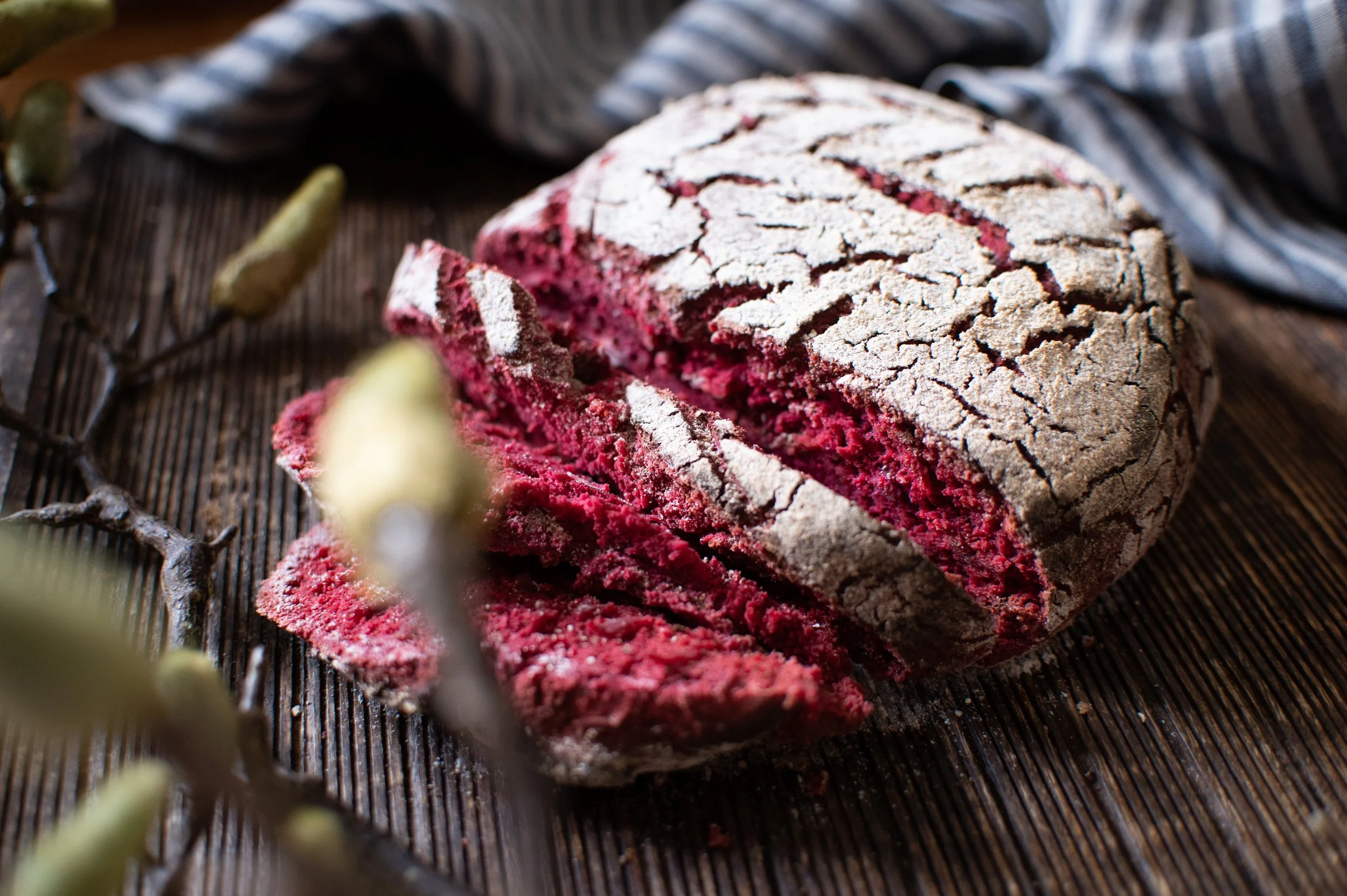
Gluten-free Beetroot Bread
Preparation time: 30 minutes
Rising time: 2 hours
Baking time: 45–50 minutes
Servings: 12
Ingredients
8 g dried yeast or 24 g fresh yeast
20 g caster sugar
400 g water
20 g psyllium fibre
12 ml apple cider vinegar
130 g buckwheat flour
100 g potato starch
90 g brown rice flour
50 g beetroot powder
10 g salt
Method
In a small bowl, mix the yeast, sugar, and 150 g (½ cup + 2 tbsp) warm water. Set aside for 10–15 minutes, or until the mixture becomes foamy.
In a separate bowl, mix the psyllium fibre with 250 g (1 cup) water. After 15–30 seconds, the mixture will form a gel.
In a large bowl, combine the buckwheat flour, potato starch, brown rice flour, beetroot power and salt, mixing well until evenly distributed.
Add the yeast mixture, psyllium gel, and apple cider vinegar to the dry ingredients. Knead until a smooth dough forms and begins to pull away from the sides of the bowl, about 5–10 minutes. This can be done by hand or using a stand mixer fitted with a dough hook.
Turn the dough out onto a lightly oiled surface and gently knead into a smooth ball. Place it into a lightly oiled bowl, seam side down, cover with a damp tea towel, and leave to rise in a warm place for about 1 hour, or until doubled in size.
Once risen, place the dough onto a lightly floured surface and gently shape it into a tight ball, taking care not to knock out too much air. Place it seam side down.
Transfer the dough to a round proving basket or bowl. Cover with a damp tea towel and leave to rise for another hour in a warm place, or until doubled in volume.
While the dough is proving, preheat the oven to 250°C.
Once risen, turn the dough out onto a piece of baking paper and score the top with a pattern of your choice.
Bake at 250°C with steam for 20 minutes. Do not open the oven door during this stage, as the steam is essential for proper crust development.
After 20 minutes, remove the tray of water from the oven, reduce the temperature to 230°C, and bake for a further 30 minutes in a steam-free environment. The loaf should be a deep, red dark brown. If it browns too quickly, loosely cover with aluminium foil, shiny side up, and continue baking until fully cooked.
Transfer the bread to a wire rack and allow it to cool completely before slicing.
Storage
Store the gluten-free bread in an airtight container or wrapped in a tea towel in a cool, dry place. It will keep well for 3–4 days.